
How it works
Listen. Understand.Strengthen. Review.
It isn't a one-off survey or another short-term initiative. Bounce Together is a continuous whole-school cycle that helps you understand and strengthen the happiness and psychological fitness of pupils, staff and families.
Curriculum & resources by
01 · Listen
What are pupils, staff and familiesexperiencing?
Gather meaningful insight with validated measures. You get a richer picture of how people experience school: happiness, belonging, relationships, confidence, safety, support and readiness to navigate challenge, change and opportunity.
- Pupil wellbeing, safeguarding and SEMH surveys
- Staff wellbeing and parent & carer surveys
- The free Happy Schools Index for pupil life satisfaction
- Baselines and national benchmarks from day one

02 · Understand
What do the findingsreveal?
We bring the findings together to show strengths, possibilities, pressures, patterns and differences across your community. You get clear interpretation, not data alone. The aim isn't only to find what's wrong. It's also to recognise what's already working and should be protected.
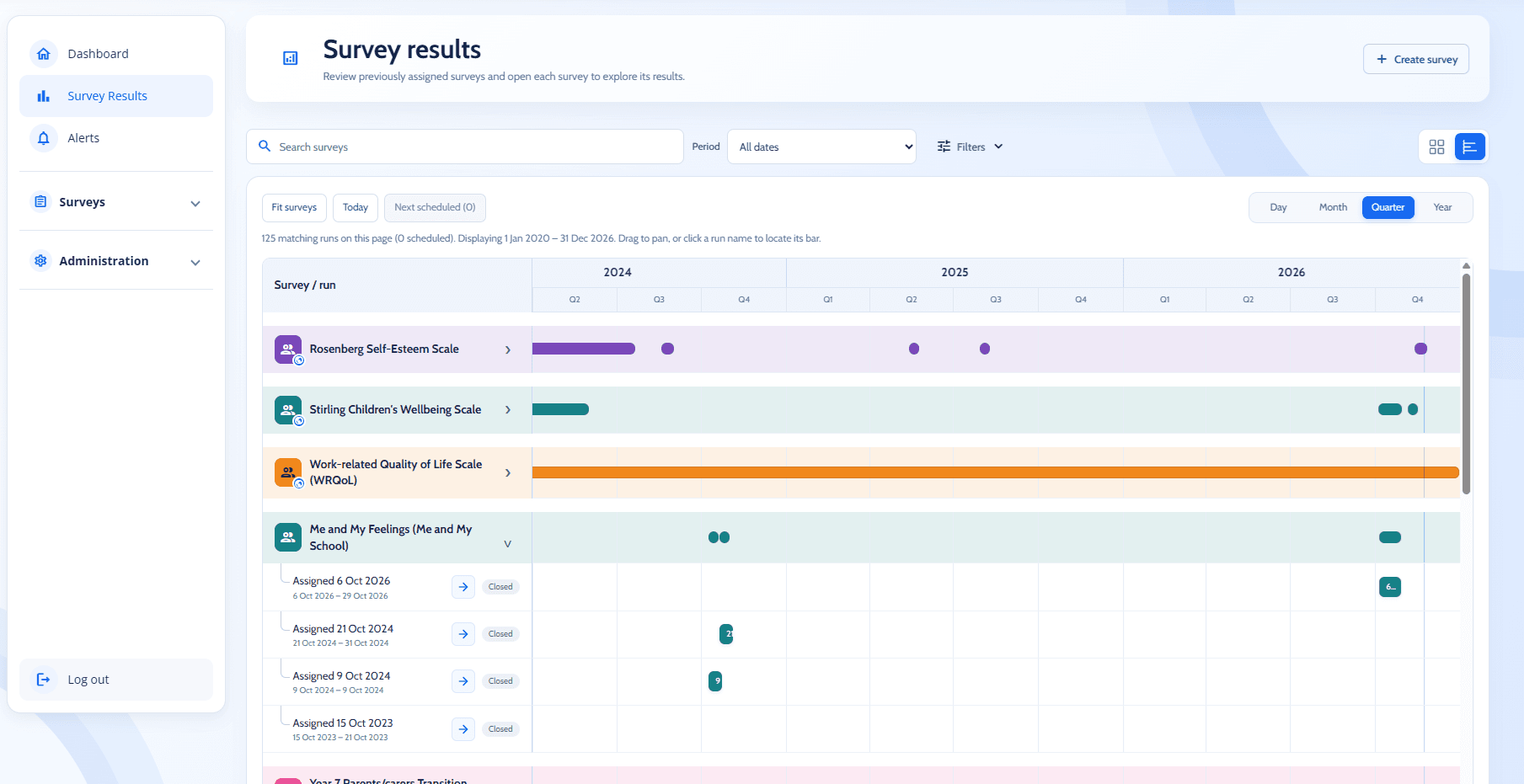
- Dashboards by year group, cohort and pupil group
- BounceAI turns findings into clear strengths, priorities and next steps
- Expert interpretation and guided leadership conversations
- Evidence for governors, trusts and Ofsted

03 · Strengthen
What should be protectedor strengthened?
Use the insight to agree priorities and take practical, evidence-led action. Support is shaped by what your own community has said, not a generic package imposed from outside. Curriculum and resources carry the Bounce Forward quality mark.
- Pupil learning in practical psychological fitness
- Staff CPD and a shared language across school
- Better Prepared for Life for parents and carers
- Guidance for embedding it in everyday school life

Psychological fitness
Five competencies we strengthen
Psychological fitness is the combination of mental resilience and emotional wellbeing that helps people regulate, recover and adapt. These capacities can be taught, practised and strengthened.
Self-awareness & compassion
Understand thoughts, feelings and patterns, and respond to ourselves and others with kindness.
Self-regulation
Create space between emotion and action, and use simple anchors to regulate, recover and adapt.
Flexible & realistic thinking
Notice unhelpful thinking habits, test the evidence and reframe thoughts accurately, not artificially.
Hope & optimism
See choices, pathways and next steps, building agency and self-efficacy through challenge and change.
Human connection
Use relationships to regulate and recover, with listening, responsibility, boundaries, repair and reconnection.
04 · Review
What is changing, and whatshould happen next?
Return to the evidence to see what has changed, where progress is being made and what needs continued attention. Measurement becomes an ongoing process of learning and improvement, not a one-off exercise.
- Two-point re-surveying to track life satisfaction and psychological growth
- Compare cohorts and terms side by side
- Impact reporting for leaders, governors and trusts
- Decide what to sustain, adapt or develop next
Start anywhere.Build what lasts.
Begin with pupils or staff completely free, then connect the parts that matter most to your community.