
Evaluating your school against the "Gold Standard": A guide to the DfE’s 8 Principles
Achieving the "Whole-School" vsion: Navigating the DfE 8 Principles confidently

As a Senior Mental Health Lead (SMHL), you aren't just managing a checklist; you are cultivating an ecosystem where every student and staff member can thrive. The Department for Education (DfE) and Public Health England (PHE) have established 8 Principles that serve as the "gold standard" for this whole-school approach.
Evaluating your setting against these principles is a continuous cycle of self-reflection, planning, and monitoring. Here is how to move beyond basic compliance and achieve true best-practice alignment.
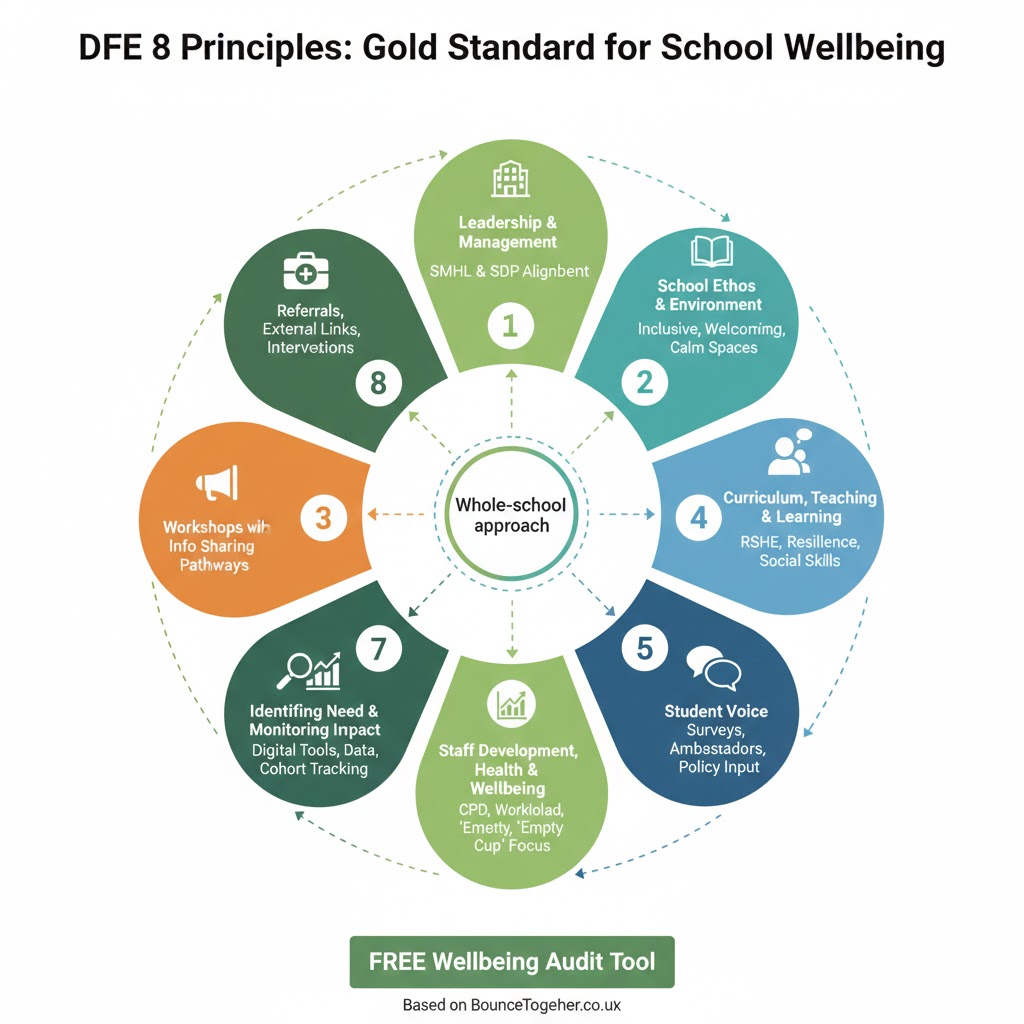
First of all, let's recap. What are the 8 principles? (see official document from the DfE here)
- Leadership and management
- Ethos and environment
- Curriculum, teaching and learning
- Student Voice
- Staff Development
- Identifying need a monitoring impact
- Working with Parents and Carers
- Targeted support and referrals
1. Leadership and management: The strategic anchor
To meet this principle, mental health must be more than a policy “on a shelf”. it must be a core strategic priority.
- The Gold Standard: Appoint a link governor specifically for mental health who meets with you at least termly to review progress
- Tip from the Field: Many schools now establish a Staff Wellbeing Working Group that includes pastoral leaders, SENCOs, and teaching assistants to ensure "collective responsibility"
2. Ethos and environment: "Walking the talk"
The physical and social environment of your school acts as a silent teacher.
- The Gold Standard: Conduct a "sensory walk" through your school. Does the entrance feel welcoming? Are there "calming zones" or green spaces accessible during break times?
- Best Practice: Schools that excel here often adopt restorative approaches to behaviour management, focusing on underlying emotions rather than just clear-cut consequences.
3. Curriculum, teaching and learning: Embedding resilience
Mental health should not be restricted to a single PSHE hour.
- The Gold Standard: Map social and emotional learning across the wider curriculum, such as exploring emotional regulation through characters in English or resilience through PE and the arts
- Tip: Use "distancing techniques" in lessons to allow students to discuss sensitive topics safely without feeling exposed.
4. Enabling student voice: Authentic agency
Giving students a say isn't just about a suggestion box; it’s about agency.
- The Gold Standard: Move to a "you said, we did" model in assemblies (You can run a free pupil voice survey on BounceTogether!). If students identify a "bullying hotspot" in the playground, show them exactly what steps the school took to address it.
- Best Practice: Train Wellbeing Ambassadors or peer mentors who have a dedicated role in leading awareness days and anti-bullying programs.
5. Staff development, health and wellbeing
You cannot pour from an empty cup. Staff must feel equipped and supported.
- The Gold Standard: Provide regular professional supervision for staff on the front lines, such as those dealing with high-level safeguarding or bereavement.
- Tip: Use anonymous staff surveys to identify specific training gaps. Is it trauma-informed practice or supporting anxious pupils?.
6. Identifying need and monitoring impact
This is where many schools struggle: moving from reactive "firefighting" to proactive screening.
- The Gold Standard: Use validated scales (like the Stirling Children’s Wellbeing Scale - run it free on BounceTogether) to establish a baseline and measure whether your interventions are actually working.
- Best Practice: Create a "referral toolkit" that is student-facing, making it clear exactly who to talk to and what happens next.
7. Working with Parents and Carers: Building the bridge
The family is a vital partner in the "whole-school" ecosystem.
- The Gold Standard: Create a Digital Wellbeing Hub on your school website with resources for parents to use at home, ensuring continuity between school and home life.
- Tip: Host regular drop-in sessions for parents on topics like managing exam stress or emotional regulation
8. Targeted support and referrals: Coordinated care
Managing the threshold between "mild distress" and "clinical need" is essential.
- The Gold Standard: Have clear, documented referral pathways to external partners like MHSTs or CAMHS, and monitor the wait times for these services.
Simplify your audit with integrated intelligence
To help you manage this complex process, we have produced a free Wellbeing Audit Tool designed to move your evidence-gathering from static documents to an automated, organized system. The tool provides an AI-powered analysis and report that highlights your progress against the 8 principles, complete with a glossary of output to help you explain technical findings to governors or inspectors. You can use it as a central hub to record your evidence from policy links to survey results, ensuring you are always "Ofsted-ready" without the administrative drudgery.
Related articles
.png)
Measuring the Impact of Your Mobile Phone Policy: What Ofsted’s Updated Guidance Really Means for Schools
From April 2026, Ofsted will assess the impact of mobile phone policies in schools. Discover how pupil voice and structured surveys can evidence improvements in focus, behaviour and wellbeing.
.png)
A Year of Listening, Learning and Supporting: Reflecting on 2025 With Our School Community
It’s been a year of change, challenge and remarkable resilience in schools — and we’re proud to have played a small part in helping communities understand wellbeing more clearly and act on it with confidence.

What Does ‘Good’ Wellbeing Look Like? Using National Baselines to Understand Your Results
Discover what ‘good’ wellbeing really looks like in schools. This article explores how national baseline data transforms wellbeing results from numbers into meaningful insight — helping leaders understand context, identify priorities, and evidence real impact.